




For contractors and service businesses operating in the specialty coatings space, there is a fundamental truth that separates businesses that struggle from businesses that thrive: the most expensive customer you will ever acquire is a new one. Every time you bid a job from scratch, invest in marketing, and spend hours qualifying a prospect, you are starting at zero. But when you transform a one-time coating application into a long-term service contract, you change the entire economics of your business — and the results can be transformative.
At INSECO, we have worked alongside contractors and commercial applicators for nearly three decades. We have seen firsthand how the right product strategy, combined with a service contract model, creates sustainable, compounding growth that holds up even when markets shift. This post is a practical guide to building that model using specialty coatings as the foundation.
Why Specialty Coatings Are the Perfect Foundation for a Service Contract Model
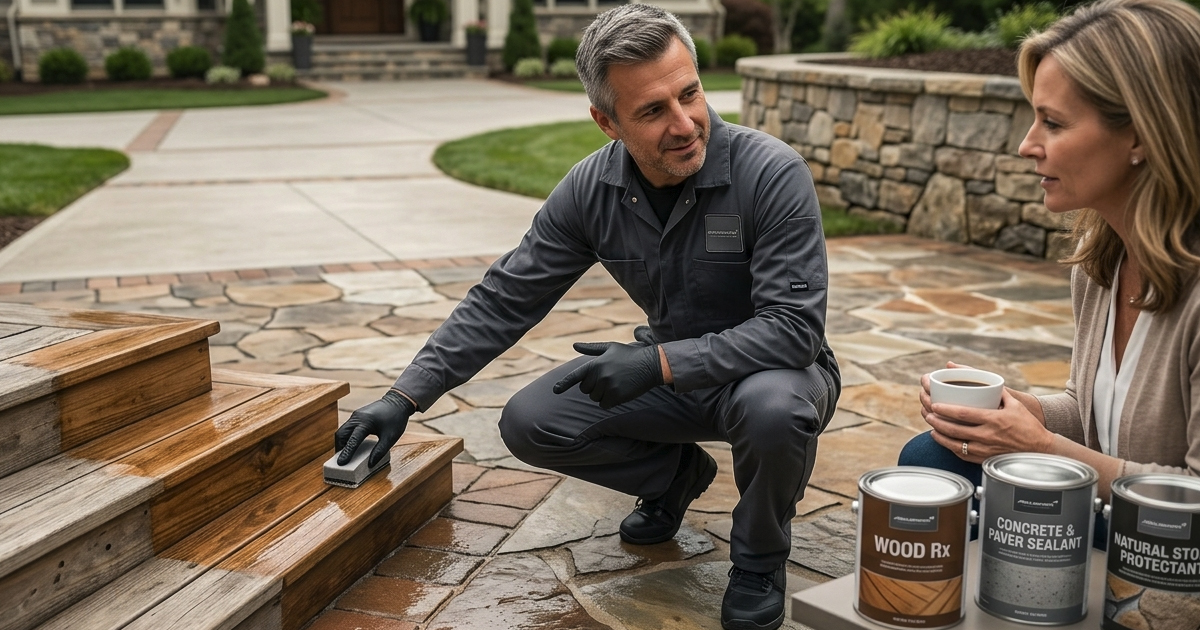
Not every trade service lends itself naturally to recurring contracts. Specialty coatings are different. Wood surfaces exposed to UV radiation, moisture, and foot traffic require ongoing maintenance. Concrete driveways and patios accumulate stains, wear, and environmental damage. Brick pavers shift, absorb moisture, and lose their protective finish over time. Natural stone is porous and vulnerable without consistent resealing. Every surface you treat today will need attention again — the only question is whether you will be the one who does it, or whether you will let that opportunity walk out the door.
Premium products like INSECO's WOOD Rx are specifically engineered for longevity and performance. That means you can speak with authority when you tell clients exactly when reseal intervals are recommended, what to watch for between service visits, and what the cost of neglect looks like over a five-year horizon. That knowledge is your leverage — and it is what allows you to position service contracts not as an upsell, but as the responsible, professional recommendation.
Surface Types That Naturally Support Recurring Service Agreements
- Wood decks and fences: Typically require resealing every one to three years depending on exposure, wood species, and original preparation quality. High-traffic decks may need more frequent attention.
- Concrete driveways and garage floors: Commercial-grade sealers can last two to five years, but traffic volume, chemical exposure, and regional climate all create variability that justifies scheduled inspections.
- Brick pavers: Subject to joint sand erosion, efflorescence, and color fade. Annual or biannual service agreements protect the investment and keep properties looking sharp year after year.
- Natural stone surfaces: Marble, travertine, slate, and limestone are particularly porous and responsive to environmental damage. Clients with high-end stone installations are ideal candidates for premium maintenance programs.
- Commercial properties: Office parks, retail centers, hospitality facilities, and multi-unit residential properties all have multiple coated surfaces requiring consistent upkeep — and they often have facilities managers who prefer predictable vendor relationships over reactive one-time calls.
Structuring a Service Contract That Clients Actually Want to Sign
The biggest mistake contractors make when attempting to offer service contracts is building them around what is convenient for the contractor rather than what is valuable to the client. A service agreement has to solve a real problem for the buyer. That problem is not abstract — it is the anxiety of wondering whether their expensive deck, driveway, or stone patio is degrading while they are not looking. Your job is to remove that anxiety with a structured, transparent program.
The Core Components of a Strong Specialty Coatings Service Agreement
An effective contract in this space typically includes several key components. First, a documented baseline inspection conducted at the time of the initial application. Photographs, surface condition notes, product specifications, and application records should all be captured and stored. This baseline becomes your proof of work and your starting point for every future service visit.
Second, a clearly defined inspection and maintenance schedule. Whether you are offering annual, biannual, or seasonal visits, clients need to know exactly what they are getting and when. Ambiguity breeds cancellations. Specificity builds trust.
Third, a tiered pricing structure that gives clients options without overwhelming them. A basic tier might include a scheduled inspection and minor touch-up work. A mid-tier might add a full surface cleaning and spot treatment. A premium tier delivers complete resealing on the agreed schedule with priority scheduling and a performance guarantee. Giving clients the ability to choose their level of service increases conversion rates significantly.
Pricing Your Contracts for Profitability and Retention
Pricing service contracts in the coatings business requires you to think in terms of lifetime customer value rather than per-job margin. A client who signs a three-year maintenance agreement for their commercial property is worth dramatically more than a one-time job, even if the individual contract price feels modest. When calculating your contract pricing, factor in your true cost of labor and materials per visit, your administrative overhead for contract management, the value of your reduced marketing cost for retained clients, and a reasonable margin that reflects the expertise and reliability you are delivering. Many successful contractors offer a modest discount on annual contract pricing compared to individual service call rates — not because they are leaving money on the table, but because they are trading a small price reduction for the certainty of a guaranteed revenue stream.
Using INSECO Products to Anchor Your Service Contract Reputation
Your product selection directly affects your ability to sell and retain service contracts. If you are applying inferior sealers that fail prematurely or require emergency reapplication, you will spend your time managing complaints instead of building recurring revenue. This is where working with a proven manufacturer like INSECO becomes a true business asset, not just a material decision.
INSECO's WOOD Rx and the broader INSECO product line are formulated for consistent, measurable performance. When you can tell a client that the product you are applying has a documented performance track record supported by nearly thirty years of field experience, you are selling confidence — and confidence is what closes service contracts. Clients who see visible, lasting results from your first application are far more likely to sign an ongoing agreement than clients who see a surface that looks good for six months and then begins to degrade.
Technical Knowledge as a Sales Tool
INSECO's comprehensive technical assistance is another competitive advantage worth leveraging explicitly in your service contract sales process. When you can walk a client through the science of how moisture infiltration damages wood fibers over time, explain how UV radiation breaks down surface coatings at a molecular level, or demonstrate why surface preparation quality directly determines how long a sealer will last, you are positioning yourself as a trusted expert rather than a commodity vendor. That positioning makes your contracts stickier, your pricing more defensible, and your referrals more consistent.
Building the Systems That Make Service Contracts Scalable
Service contracts are only a growth engine if you can deliver on them reliably at scale. The worst outcome in this business is signing ten service agreements and then failing to execute them professionally because your operations are not built to support the volume. Before you aggressively pursue a contract-based model, make sure you have the following systems in place.
Client Records and Maintenance Tracking
Every client under a service contract should have a detailed digital file that includes their surface inventory, application history, product specifications, inspection notes, and upcoming service dates. This does not have to be a complex system — a well-organized CRM or even a structured spreadsheet can work in the early stages — but it has to be consistent and accessible. When a service call comes up six months from now, you should be able to pull up exactly what was applied, when, and in what condition the surface was left.
Scheduling and Communication Protocols
Clients who sign service agreements expect proactive communication. Set up automated reminders for upcoming service visits, send pre-visit confirmation messages, and follow up after each service call with a brief summary of what was done, what was observed, and when the next visit is scheduled. This level of professionalism differentiates you from every contractor who sends a crew, does the work, and disappears until the next call comes in.
Staff Training and Product Consistency
Service contracts live and die by consistency. If a client's property looks different depending on which crew shows up, the relationship erodes quickly. Invest in thorough training on INSECO product application protocols, surface preparation standards, and inspection procedures. Make sure every technician on your team can deliver the same quality result regardless of which job site they are working. That consistency is what turns service contracts into long-term relationships — and long-term relationships into the referral network that fuels your next phase of growth.
The Compounding Growth Effect of a Contract-Based Coatings Business
Here is the business case stated plainly. If you close ten service contracts this year at an average annual value of two thousand dollars each, you have added twenty thousand dollars in predictable recurring revenue to your business. Next year, if you retain eight of those clients and add ten more, you have thirty-six thousand in contracted revenue before you book a single new one-time job. By year five, if you manage retention well and continue growing your contract base, you have built a business that generates meaningful revenue before the season even starts — and that changes everything about how you operate, hire, invest, and plan.
Specialty coatings are not just a service. When structured correctly around high-performance products from a manufacturer like INSECO, combined with a disciplined service contract model, they become the foundation of a business that grows predictably, retains clients loyally, and compounds value year over year. The window for contractors who want to lead in this space is open — but it rewards those who build the right systems now rather than waiting until the competition catches up.